

RIBBING
in category: RIBBING
Chosen
Price
Color
Color number
Product number
Composition
Weight
Width
Yield
Availability
Cotton ribbing for sewing cuffs, necklines, sweatshirt hems and trouser legs. Choose a plain or ribbed structure and a colour; check the weight and the purchase unit.
List of products




Ribbing for sewing – uses
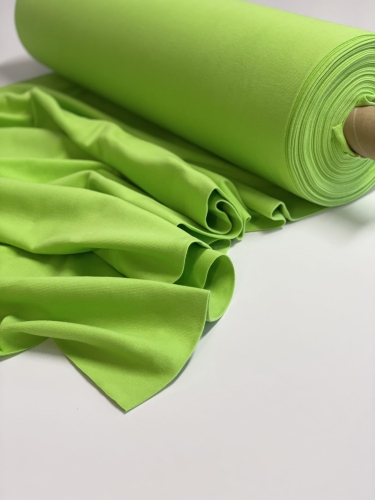
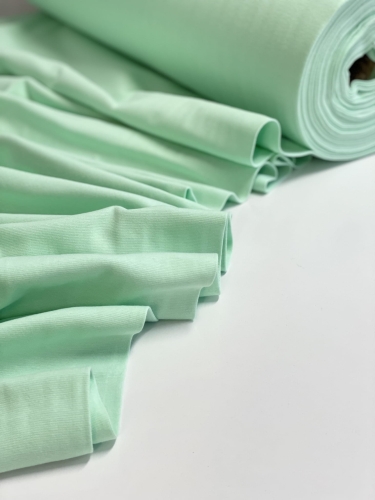
Ribbing is a knit fabric with good recovery used to finish clothes. You can use it for cuffs, necklines, sweatshirt hems or the legs of joggers. In this category you are looking for fabric for sewing, not a ready-made piece matched to a specific garment size.
Plain or rib ribbing for a sweatshirt?
The plain variant gives a subtler finish, while the rib one emphasises the structure of the cuff. Compare the weight, composition and recovery, matching them to the weight of the main knit fabric and the requirements of the pattern. Thicker ribbing is not always suitable for a lightweight T-shirt. Colours are best matched using samples of both fabrics.
Ribbing in a tube – how to read the width
For fabric knitted as a tube, pay attention to how the width is given: the width of the tube laid flat differs from its width once cut open. Follow the description of the specific product. Also check the sales unit and the length that corresponds to one piece in the basket before calculating the length you need.
Match the fabric to the set
For the body of a sweatshirt, compare French terry and brushed fleece. To finish a T-shirt, pair the ribbing with cotton jersey with elastane or 100% cotton single jersey. Determine the length of the ribbing strip according to the pattern and a recovery test; one ratio does not suit every fabric. Before sewing, prepare the knit fabrics according to their care instructions.
Plain and rib ribbing – available types
Compare plain 1/1 ribbing and 2/2 rib ribbing. In the subcategories you will find variants that differ in weight and finish. For example, you can see cotton rib ribbing 280 g/m² and the 450 g/m² variant. Choose according to the parameters of the specific product and how the ribbing works with the main knit fabric.
Ribbing for sweatshirts, T-shirts and trousers
A T-shirt neckline usually needs a more delicate finish than the hem of a heavy sweatshirt. A cuff should keep a comfortable circumference and return to shape, and the waistband or hem should match the construction of the pattern. Ribbing can also be used to replace worn cuffs on ready-made clothes. Before such a repair, measure the piece and assess the thickness of the fabric it will be sewn to.
How to buy cotton ribbing by the metre
At CoStories, one sales unit of ribbing corresponds to 0.5 m in length. Two units make 1 m. The tube width is a separate parameter: read it on the product page so you can plan the strips to cut correctly. Do not calculate ribbing in the same way as knit fabric sold in 1 m units.
Questions before sewing
Does the ribbing have to be exactly the same colour as the sweatshirt?
It can be tone-on-tone or contrasting. In both cases, compare samples and decide which effect you want.
How much shorter should the ribbing strip be?
It depends on the recovery of the fabric, where it is sewn in and the pattern. Do a test; one fixed ratio will not work for every neckline, waistband and cuff.

Delivery tailored to your order
You will see the current delivery methods, cost and estimated delivery time before placing your order.
Have a question before buying?
Call: +48 515 094 907 · Mon–Fri 8:00–16:00
Write to us →
Best deals
Your favourite products, now even cheaper!